


Black Cumin Oil – Latest Studies 08.2026
Updated: Aug 15
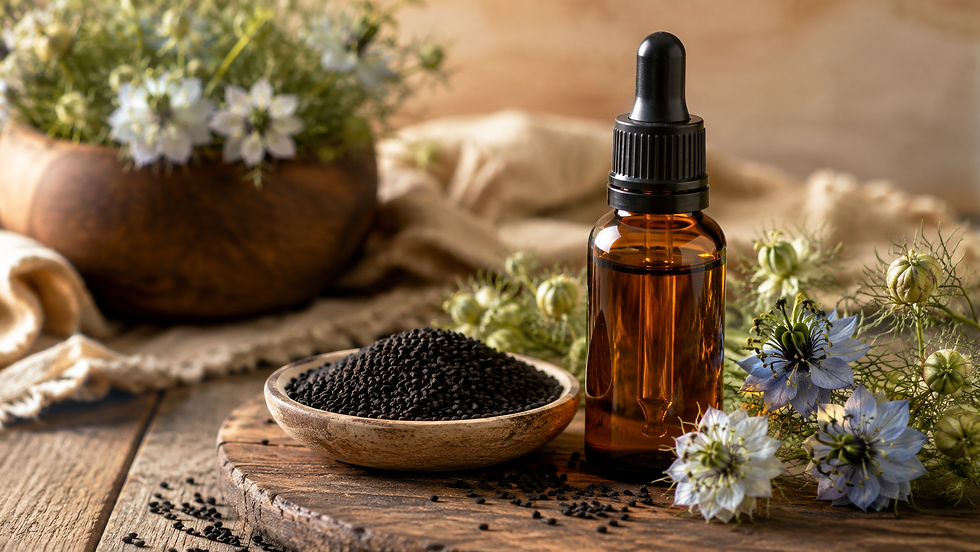
Black cumin oil is obtained from the seeds of Nigella sativa. New randomized studies examine different oils and special extracts, among other things for seasonal allergy, sleep problems, metabolic markers and knee osteoarthritis.
The product form is important: the dose and the content of thymoquinone – one of the most important constituents studied – differ in some cases considerably. Results for a standardized extract therefore do not automatically apply to every black cumin oil.
Seasonal allergy symptoms
In a double-blind, placebo-controlled study from 2024, 65 people with seasonal allergic rhinitis took 250 milligrams of an oil standardized to 5 percent thymoquinone together with 2.5 milligrams of piperine, or a placebo, twice daily for 15 days.
Allergic rhinitis includes typical complaints such as a runny or blocked nose, sneezing and itching. The eyes can also be affected. In the oil group, both the complaints affecting the nose and eyes and the frequency and duration of the symptoms decreased more than under placebo. [1]
Inflammatory and metabolic markers
A crossover study with 46 women with overweight or obesity examined 2,000 milligrams of cold-pressed black cumin oil daily over two eight-week phases.
Compared with placebo, the gene activity and the blood levels of IL-1β and IL-6 decreased. These signalling substances are involved in inflammatory reactions. Leptin also decreased, a hormone from fatty tissue that is involved, among other things, in the regulation of hunger and energy balance. In addition, small improvements were seen in fasting insulin and BMI.
In the crossover design, each participant received both treatments one after the other. In between there was a four-week washout phase. [2]
Sleep and perceived stress
A standardized black cumin oil extract was tested in 2024 in 70 people with non-restorative sleep. After seven days with 200 milligrams daily, sleep efficiency and total sleep time improved compared with placebo.
These values were recorded by actigraphy. In this method, a device worn on the wrist records movements and sleep-wake patterns. The participants also fell asleep more quickly and were awake for a shorter time after falling asleep. The subjectively perceived recovery after sleep also improved. [3]
A 90-day study with 72 people likewise used 200 milligrams daily. The PSQI, a questionnaire on sleep quality, and perceived stress improved compared with placebo. At the same time, salivary melatonin rose, while cortisol and orexin A fell. These substances are involved in the regulation of sleep, wakefulness and stress responses.
What was examined was a special standardized oil extract and not an ordinary culinary oil. [4]
Knee osteoarthritis: oral and topical
A three-arm, double-blind study from 2023 examined 45 people with knee osteoarthritis over six weeks. One group took 2.5 millilitres of black cumin oil twice daily, another used it topically.
With oral use, hs-CRP, malondialdehyde and total antioxidant capacity improved. These are measurements for inflammation and oxidative stress respectively. Both oral and topical use also improved parts of quality of life compared with placebo. [5]
A study published in 2026 with 150 people compared foot reflexology and knee massage with black cumin oil or placebo oil, as well as a control group.
After six weeks, pain and exhaustion decreased in the oil massage groups. The combination of foot reflexology and black cumin oil performed best. Because oil and massage were applied together, the observed effect cannot be attributed to black cumin oil alone. [6]
Conclusion
The more recent human studies provide positive signals for seasonal allergy symptoms, certain inflammatory and metabolic markers, non-restorative sleep and complaints in knee osteoarthritis.
For interpretation, the exact product form is decisive. Standardized oil, concentrated oil extract, cold-pressed oil and topically applied oil are scientifically different forms of investigation.
Sources
[1] A randomized, double-blind, placebo-controlled study to evaluate the benefits of a standardized Nigella sativa oil containing 5% thymoquinone in reducing the symptoms of seasonal allergy. Medicine, 2024.
[2] A crossover randomized controlled trial examining the effects of black seed supplementation on IL-1β, IL-6 and leptin, and insulin parameters in overweight and obese women. BMC Complementary Medicine and Therapies, 2024.
[3] Exploring the short-term influence of a proprietary oil extract of black cumin on non-restorative sleep: A randomized, double-blinded, placebo-controlled actigraphy study. Frontiers in Nutrition, 2024.
[4] A proprietary black cumin oil extract modulates stress-sleep-immunity axis safely: Randomized double-blind placebo-controlled study. Frontiers in Nutrition, 2023.
[5] The efficacy of Nigella sativa L. oil on serum biomarkers of inflammation and oxidative stress and quality of life in patients with knee osteoarthritis: A parallel triple-arm double-blind randomized controlled trial. Food Science & Nutrition, 2023.
[6] The Effect of Foot Reflexology and Knee Massage With Black Cumin Seed Oil on Knee Osteoarthritis Symptoms. Holistic Nursing Practice, 2026.
13.08.2026
Author: Alireza Mohtashami
Related reading
About the AuthorAlireza Mohtashami is the author of "Plant-Eater's Helper", a certified mushroom expert of the German Mycological Society and a trained practitioner of herbal medicine. He continuously reviews current studies on nutrition, nature and holistic health and presents them in a practical way, free of ideology. More about the author
The Book on This Topic"Plant-Eater's Helper" is the guide to plant-based nutrition: critical nutrients and antinutrients, protein requirements and plant-based sources, and bioavailability through sprouting, soaking, cooking and fermenting. Plus practical chapters on sport, pregnancy and highly processed foods. Currently available in German only; an English edition is in preparation. All about the bookReading sample (PDF) · Autorenwelt · Amazon · Romeon Verlag · Thalia


Comments